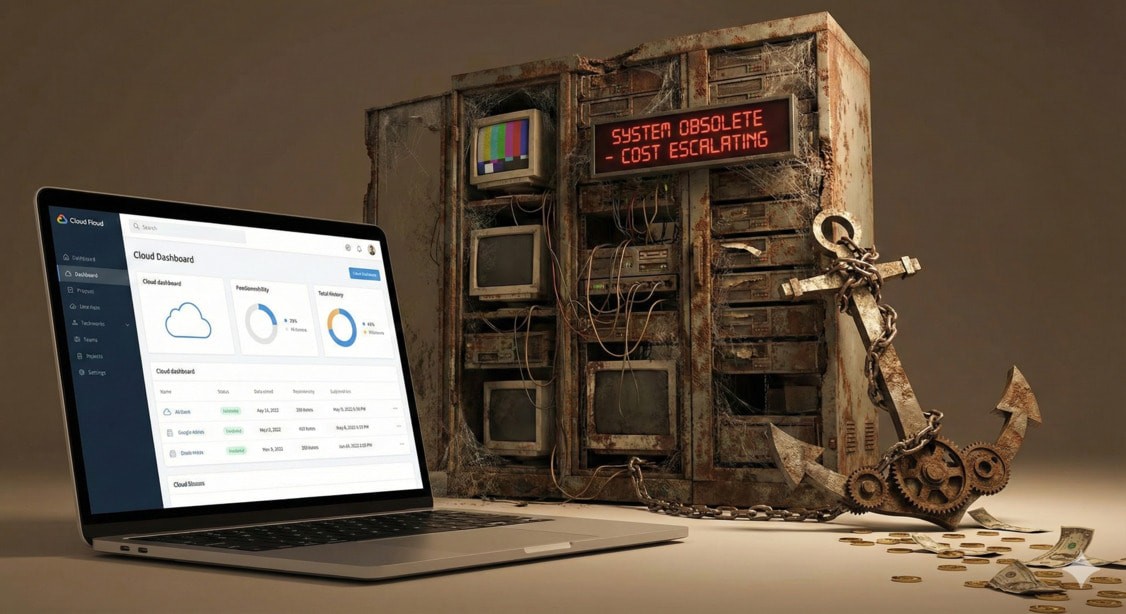
In the world of enterprise CMS management, there is a common philosophy that often feels like the safest path: If the site is running, don't touch it. However, there is a hidden "Legacy Tax" associated with keeping aging systems on life support. Whether it is an old Kentico site or an older .NET environment, the costs of maintaining legacy technology eventually eclipse the investment required to modernize. When infrastructure providers begin demanding long-term contracts for aging hardware, or when simple bugs turn into multi-day investigations, the "safe" path becomes the most expensive one.
Here is a breakdown of why staying current is a financial necessity, not just a technical preference.
1. The Troubleshooting Trap: Diminishing Returns on Expertise
As codebases age, they become brittle. Dependencies that were industry standard five years ago become obsolete "ghosts" in the machine. A task that should take thirty minutes—such as identifying a routing error or a data bottleneck—can easily turn into a 15-hour deep dive.
When developers have to spend days untangling legacy logic or working around obsolete frameworks, you aren't paying for innovation; you are paying a premium just to maintain the status quo. Modern platforms like Xperience by Kentico and Agility CMS are designed with cleaner architectures that drastically reduce the time-to-resolution for common issues.
2. Infrastructure Hostage Situations
Legacy systems often require specific, older environments to run—such as SQL Server 2014 or older on-premise rack servers. Because these environments are increasingly difficult for hosting providers to maintain, they often pass those costs (and risks) down to the client.
We are seeing a trend where traditional hosting providers "force the hand" of legacy users, requiring 3-year contract commitments or imposing aggressive exit windows. Modernizing to a cloud-native or PaaS (Platform as a Service) model removes this leverage. Moving to Azure or modern cloud environments allows for "pay-as-you-go" scalability, freeing businesses from being locked into expensive, aging hardware contracts.
3. The End-of-Life Security Risk
Running on outdated software isn't just slow; it’s a liability. When a version of SQL Server or a CMS reaches its end-of-life, security patches stop. To stay compliant with data privacy regulations, companies are often forced to pay for "Extended Security Updates," which are notoriously expensive. Modernizing your stack ensures that security is baked into the platform’s evolution rather than being a costly, manual afterthought.
4. Lost Opportunity and Talent Friction
The best technical talent wants to work with modern tools. When a company stays on legacy tech, it becomes harder to find experts who are willing to support it, and those who do will charge a premium for their specialized, "archaic" knowledge.
Furthermore, while your team struggles with legacy troubleshooting, your competitors are leveraging AI integrations, headless CMS capabilities, and faster deployment cycles. The cost of a legacy system isn't just the invoice from the hosting provider—it’s the revenue lost because you couldn't pivot fast enough to meet market demands.
Modernization is a Strategy, Not a Transaction
The most dangerous mistake a business can make when facing a legacy ultimatum is rushing into the first "modern" solution they find. Technology changes too fast for a one-size-fits-all approach.
Modernization requires a high-level architectural view. It isn't just about moving code from point A to point B; it’s about analyzing your current bottlenecks, determining your actual business needs for the next five years, and selecting a stack—whether it’s Xperience by Kentico, a headless CMS, or a custom .NET cloud-native build—that aligns with your growth.
Your Advocate in the Modernization Process Moving to a new platform is a high-risk endeavor. We provide the technical management and oversight necessary to ensure your new build is executed to the highest standards. From initial needs assessment to final deployment, we act as your lead architect to ensure the project stays on track and on budget. Contact us to Partner with a Technical Lead.
